Modern Media Art "Light" Exhibition
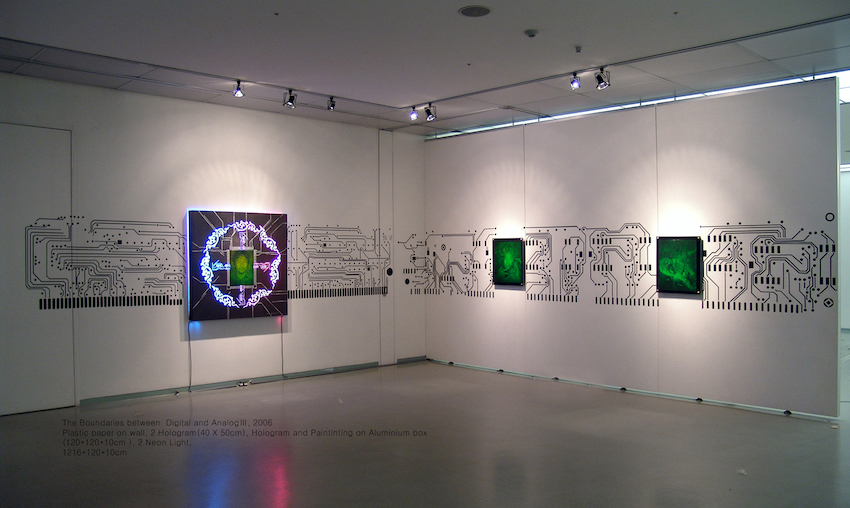
Exhibition Background
Modern Media Art “Light” Exhibition was held at the Seongnam Arts Center Museum Main Building from September 30 to October 20, 2006, to mark the first anniversary of Seongnam Arts Center. The exhibition set out to survey the flow of contemporary media art across painting, sculpture, installation, and video in a single venue, revealing multiple layers of contemporary visual culture through the shared sensation of light.
The exhibition was structured around three themes. Theme 1, Colors of Seongnam, focused on two-dimensional works. Theme 2, Light of Everyday Life, centered on sculpture and installation, presenting a space that expressed the realities spreading through rapid industrialization in the formal language of media art. Theme 3, Fantasia: Light of Illusion, highlighted the illusory qualities of light and the imaginative possibilities of media through video and installation. In this third section, Jaeeon Byun’s work was exhibited alongside works by Nam June Paik and Shigeko Kubota, creating a scene in which Korean and international media art intersected.
Artwork: Boundaries of Digital and Analog III
At the far left of the installation view, Jaeeon Byun’s major work Boundaries of Digital and Analog III appears as a new-media holographic installation combining hologram, painting on board, stainless steel, and neon. The work itself measures 480 x 120 x 13 cm, while the full installation, including the wall painting, extends to 1216 x 120 x 13 cm. The piece visualizes the sensory shifts encountered by human beings in an environment closely shaped by science and technology, constructing a holographic image across a structure reminiscent of memory-chip circuitry and moving through the wavelengths of light.
The holographic object used in the work is the artist’s own face. As this individual image emerges three-dimensionally within layers of electronic circuitry and light, the boundaries between the real and the virtual, the material and the immaterial, the digital and the analog are compressed into a single visual field. Through holography, Byun presents a self-portrait of the contemporary individual, treating technology not simply as a device but as the condition in which memory and identity are generated and transformed. The work stands as an important example of his mid-2000s practice, condensing the relationships between light and media, self and environment.