2014 UN Public Service Forum Commemorative Exhibition
Exhibition Background
The exhibition was held from June 23 to June 26, 2014 at the PR Pavilion of KINTEX Exhibition Hall 2 in Goyang, in conjunction with the 2014 UN Public Service Forum. Co-hosted by the National Museum of Modern and Contemporary Art, Korea, the Ministry of the Interior and Safety, the Small and Medium Business Corporation, and the Korea Tourism Organization, the exhibition served as a cultural program introducing forum delegates and international visitors to the visual language of Korean contemporary art.
The exhibition was organized under the theme HAPPINESS. Structured around two broad threads, self-discovery and relationships with the outside world, it began by asking what personal and social happiness might mean. In a complex modern society, where people live under different conditions and make different choices, the way we position ourselves in relation to the outside world shapes how we imagine change and pursue happiness. The exhibition sought to communicate the diverse aspirations of Korean contemporary artists working toward a better quality of life for both the individual and society.
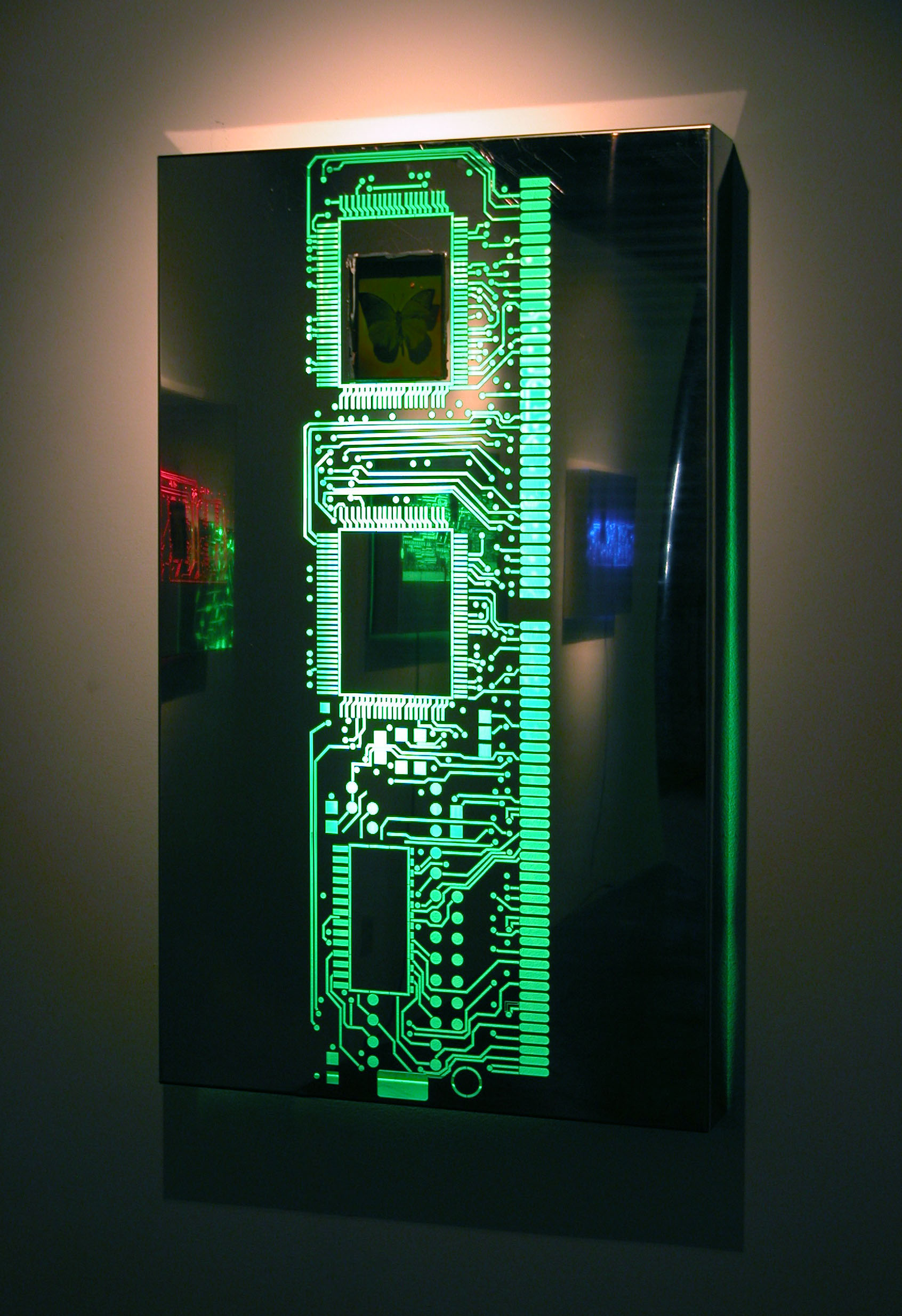
Butterfly and Circuit, 2004, Hologram on Stainless steel, Neon
Artwork: Butterfly and Circuit
Jaeeon Byun’s Butterfly and Circuit (2004) is part of the Boundary of Digital and Analogue series and is made with Hologram on Stainless steel, Neon. Inside an imagined cuboid habitat, the work brings together moving electric signals, green light, and the holographically rendered image of a butterfly, revealing a condition in which nature and modern civilization coexist within the same visual field.
The semiconductor circuitry resembles a living organism that reproduces and evolves in response to a new environment. Fueled by electrical energy, the structure radiates vitality, transforming the circuit from a technical diagram into something organic and alive. Within that system, the butterfly introduces an image of nature, visualizing a tense yet coexistent relationship between the artificial and the natural.
The circuit imagery, reflections on the stainless steel surface, and the viewer’s own figure layered onto that reflective plane collapse represented space and real space into one another. In doing so, the work evokes a condition of coexistence shaped by multiple cultures and shared ways of living, extending private perception into the realm of social relations. Within the exhibition’s theme of HAPPINESS, Butterfly and Circuit marks a meeting point between technology and nature, self and society, reality and imagination, inviting reflection on the forms of coexistence modern civilization should pursue.